

A day of subbing ends, and on the drive home you wonder whether a few evenings a week could pay more steadily than waiting for the next call. In Calgary, the families who could fill those evenings are easy to picture: the Calgary Board of Education alone counted 142,403 students this school year.
This is the Calgary companion to our guide to tutoring in Alberta, which covers the province's rule on tutoring your own students and how certification works. Here the focus is the city: who is asking for help, when requests pile up, what local teaching pay tells you about pricing, and where lessons actually happen.
Sources: Calgary Board of Education, 2026; Government of Alberta, 2026; Job Bank, 2025
Who's looking for a tutor in Calgary?
Start with the size of the public system. That figure comes from the public board's September 30, 2025 count, spread across more than 250 schools (Calgary Board of Education, 2026). Enrolment was flat compared with the year before, after the system grew by more than 17,000 students between September 2021 and September 2024 (Calgary Board of Education, 2025). The largest group is high school: 36,230 students in Grades 10 to 12.
The Calgary Catholic School District also teaches Kindergarten to Grade 12 across the city, and it currently advertises diploma preparation courses on its home page (Calgary Catholic School District, 2026). When a school district runs its own exam prep, that tells you what families are worried about.
French is the other steady source of requests. The Calgary Board of Education offers Early French Immersion from Kindergarten to Grade 12, Late French Immersion starting in Grade 7 and Intensive French in Grade 6, and no prior French is needed to register (Calgary Board of Education, 2026). Plenty of those parents don't speak French at home, so a teacher who can explain a French math worksheet or a reading log is exactly who they search for. If that's you, list it clearly; our French tutoring page shows what parents ask for.
When does tutoring demand peak in Calgary?
Demand peaks before the Grade 12 diploma exams. In 2026-27 the two big sessions run January 14 to 28 and June 11 to 28, 2027, with Mathematics 30-1 on January 20 and June 17. Families tend to start looking several weeks before each one.
The stakes explain the timing. The diploma exam is worth 30% of a student's final mark in the course, and in 2026-27 students are expected to write every diploma exam on Alberta's digital assessment platform (Government of Alberta, 2026). That second change matters for tutors: practice under timed, on-screen conditions is now part of good preparation, which suits online sessions well. Smaller sessions also run in November, April and August for students rewriting or finishing a course early.
| Diploma exam | January 2027 | June 2027 |
|---|---|---|
| English Language Arts 30-1, Part A | Monday, January 18 | Tuesday, June 15 |
| Social Studies 30-1, Part A | Tuesday, January 19 | Wednesday, June 16 |
| Mathematics 30-1 and 30-2 | Wednesday, January 20 | Thursday, June 17 |
| English Language Arts 30-1, Part B | Thursday, January 21 | Friday, June 18 |
| Biology 30 | Monday, January 25 | Wednesday, June 23 |
| Chemistry 30 | Tuesday, January 26 | Thursday, June 24 |
| Physics 30 | Wednesday, January 27 | Friday, June 25 |
Source: Government of Alberta, Diploma Examinations Program bulletin 2026-27. Morning sessions start at 9 AM.
Start Tutoring on Your Terms →Parents often arrive confused about how the diploma mark combines with the school mark. Our parent guide, what is a passing grade in Alberta, is a useful link to send them before a first lesson.
How much can you charge as a tutor in Calgary?
There is no official figure for private tutoring rates in Calgary, so start from what local teaching pays. Job Bank puts elementary and kindergarten teachers in the Calgary Region at a median of $39.90 an hour, with $25.00 at the low end and $54.95 at the high end (Job Bank, wages updated November 19, 2025). Secondary teachers sit higher, as the Alberta guide shows.
Two Calgary details shape the price. Distance: a session in Seton is a long drive from Tuscany, so set the parts of the city you'll travel to and price the drive into in-person lessons. Weather: a January cold snap can cancel a home visit but not a video call, which is one reason many tutors here offer both and set a separate online rate. Our breakdown of tutoring rates by province walks through the arithmetic, including planning time.
Where do Calgary tutoring lessons happen?
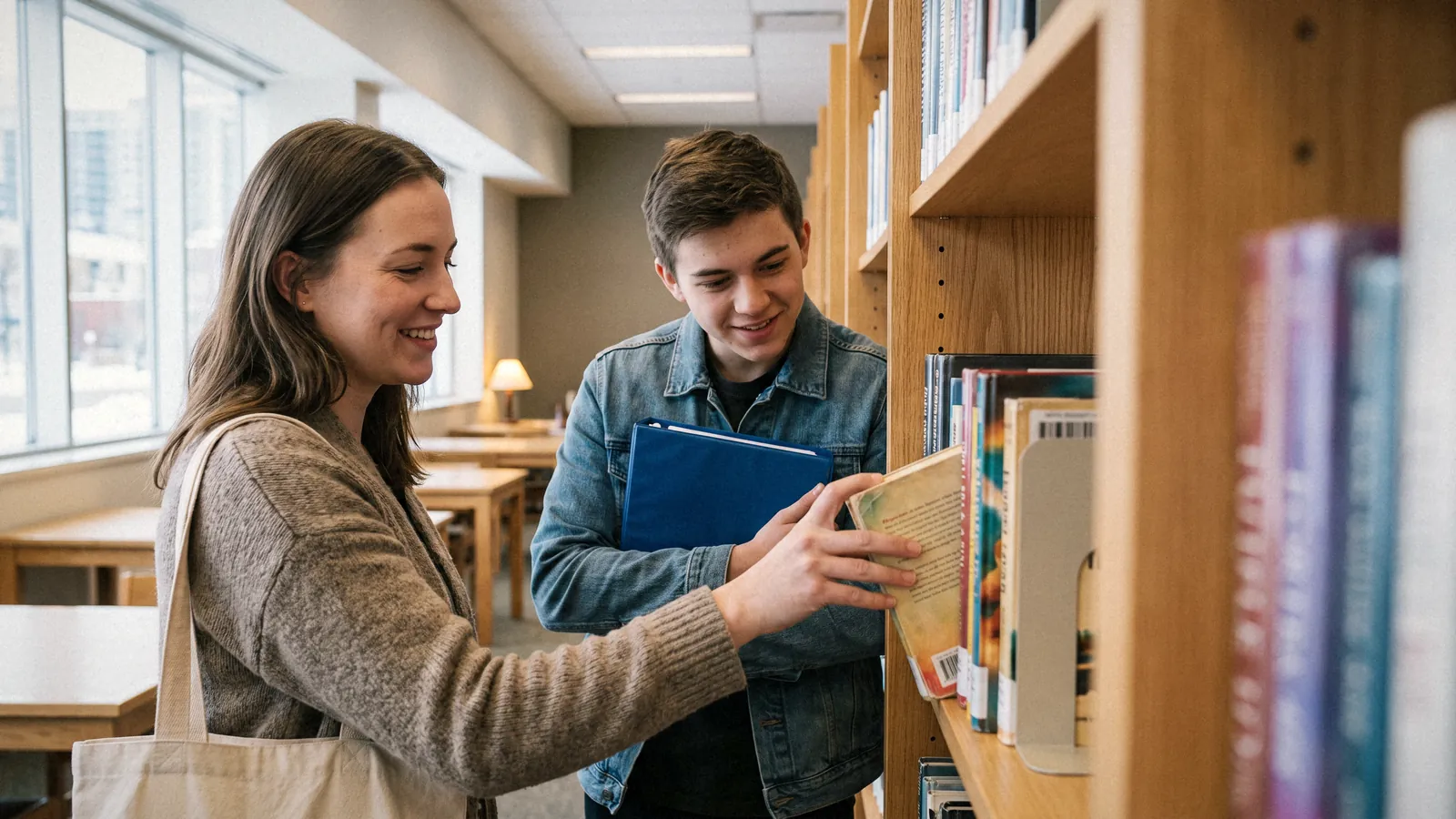
Most lessons happen in one of three places: online, at the student's home, or at a public library. Home visits are your choice, not a requirement. If you'd rather not go to a family's home, a library is a good neutral place, especially for a first meeting when a parent wants to stay nearby.
Calgary Public Library has more than 20 locations across the city (Calgary Public Library, 2026). Rooms can be booked at select locations up to 30 days ahead, online or in person, and smaller spaces at branches such as Central, Crowfoot, Fish Creek, Nose Hill, Saddletowne, Seton and Shawnessy can be booked for up to three hours a day (Calgary Public Library, 2026). Check the branch's room rules before you book, and book early in the weeks before diploma exams.
Tutoring with Connect Education
Every tutor on Connect Education is a certified teacher. Joining is free. You set separate rates for in-person and online lessons, choose your weekly hours and the parts of Calgary you'll teach in, and families send you requests that fit. A platform fee applies only when you teach. Supply teachers and retired teachers are welcome to apply too. One rule to keep in mind: don't tutor students you currently teach at school.
If you'd also like to bring in families of your own, our guide to finding tutoring students without an agency has ideas that work alongside your profile. When you're ready, read how to become a tutor or see how tutoring works for teachers.

 Certified teachers
 Online, home or library