

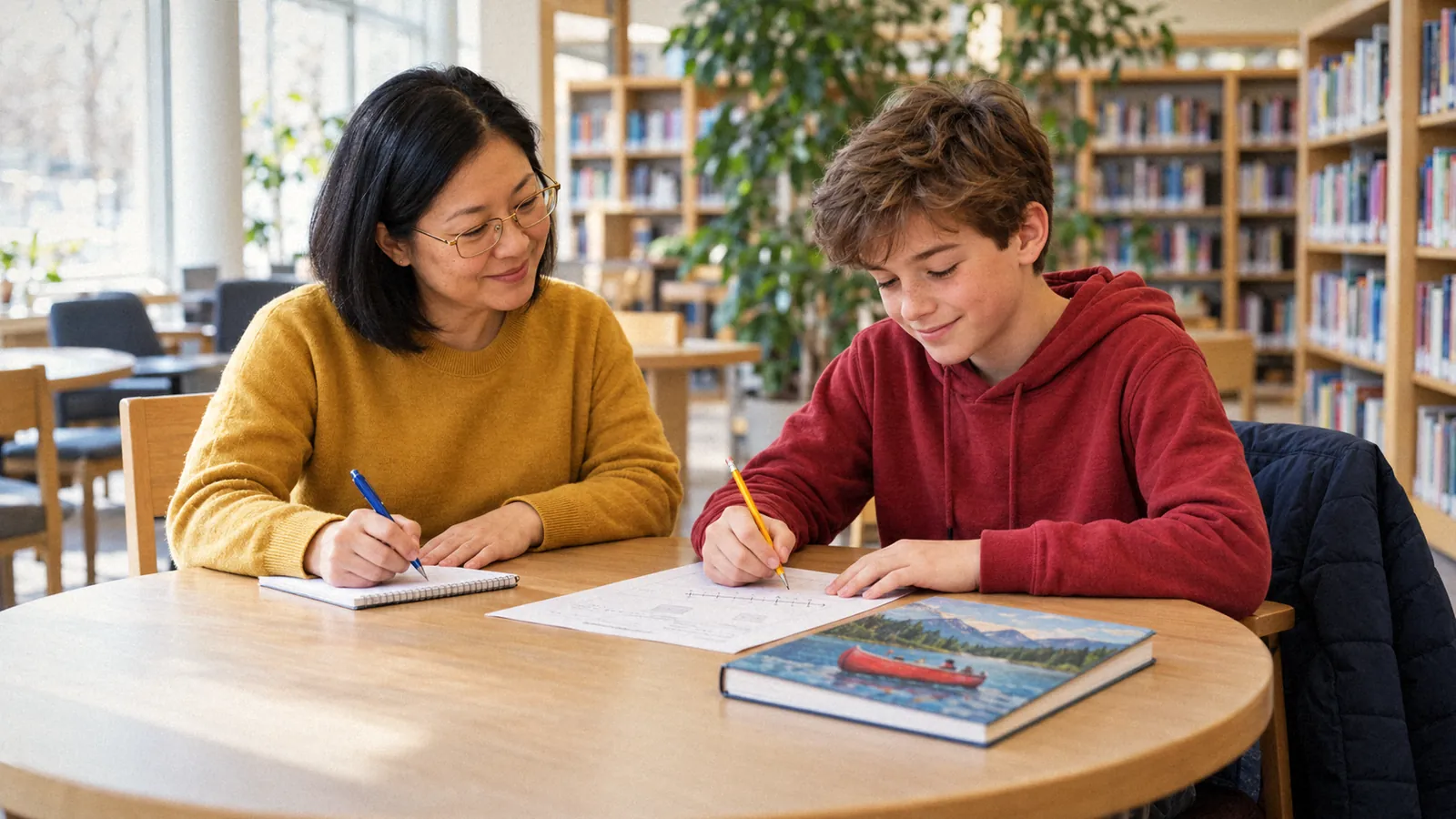
A parent in Edmonton searches for an in-person teacher and hopes a real classroom teacher turns up at the door or the library. This fall, more Alberta families have been asking Connect Education for exactly that, so this guide to tutoring in Alberta is for the certified teachers who could be that person.
It covers what the province's rules say about tutoring, who can tutor with an Alberta certificate, what families in Edmonton, Calgary and the rest of the province need help with this school year, and how to set a fair price whether you meet families at home, at a library or on a video call.
Sources: Job Bank, 2025; Government of Alberta, diploma exams, 2026; Government of Alberta, curriculum, 2026; Government of Alberta, teacher certification, 2026
Why Alberta parents are looking for tutors
Several provincial changes land on families at once this year. Kindergarten to Grade 3 classrooms began the new social studies curriculum in September 2025, and Grades 4 to 6 started it in September 2026 (Alberta Teachers' Association, 2025; Government of Alberta, 2026). Literacy and numeracy screening, already required from Kindergarten to Grade 3, is now also required in Grades 4 and 5 starting in 2026/27 (Government of Alberta, 2026).
A screening flag or a disappointing provincial achievement test (PAT) result tends to send parents looking for someone who knows Alberta's programs of study, not a general homework helper. Many of them want that person at the kitchen table, especially for younger children who find a screen hard to focus on. Others, often families with teenagers or a long drive to the nearest city, would rather book online sessions with a teacher who knows the Alberta curriculum. Our parent guide to Alberta report cards shows the questions they arrive with.
Can Alberta teachers tutor their own students?
Not for pay, in the subjects you teach them. Alberta's Code of Professional Conduct for Teachers and Teacher Leaders, in effect since January 1, 2023, says a teacher may not accept pay for tutoring a student in a subject they give that student classroom instruction in. Tutoring other students is allowed, subject to local school policy.
That wording comes from the Code itself, published with the government's companion document (Government of Alberta, 2026). The same clause bars using your position to profit from selling goods or services to students in your charge. The Code replaced two separate codes with one set of rules for every certificated teacher and teacher leader, and the Alberta Teaching Profession Commission has handled complaints under it since 2023.
In practice, that leaves three simple habits:
- Know your school authority's policy. It can add limits on tutoring students from the school where you work, so read it before you say yes to a family you know from work.
- Refer your own students on. If a parent from your class asks, point them to another certified tutor instead.
- Keep a note of any approval. When a principal confirms a tutoring arrangement is fine, write down the date and what was said.
Certification, the registry and moving from another province
Alberta Education is the only body that can assess credentials for teaching in the province. An Interim Professional Certificate is valid for three years; a Permanent Professional Certificate follows after about two years of full-time teaching and two successful evaluations, on your school authority's recommendation (Government of Alberta, 2026).
Your standing appears in the public Teacher and Teacher Leader Registry, which lists certificate type and status for certificate holders going back to 1954 (Government of Alberta, 2026). It's the same check a family or a tutoring platform can make.
If you're certified elsewhere in Canada and have moved to Alberta, the labor mobility route recognizes a valid certificate from another province or territory without extra education, training or exams. You still apply, with a Statement of Standing from each jurisdiction, and a complete file is processed within 20 business days.
Teachers who tutor here tend to fall into a few groups: full-time teachers adding a few evening hours, substitute teachers building a steadier week, newer teachers waiting on a contract, and retired teachers who still hold their certificate and miss one-on-one work.
What families need, grade by grade
Each grade band brings its own pressure point. This is where families usually ask for help:
| Grades | What's new or tested | Where a tutor helps |
|---|---|---|
| Kindergarten to Grade 3 | Literacy and numeracy screening: Kindergarten in winter, Grades 1 to 3 in fall and winter. New social studies since September 2025. | Foundational reading, letter sounds and early number sense after a screening flag. |
| Grades 4 to 6 | Screening now required in Grades 4 and 5 from 2026/27. New social studies since September 2026. Grade 6 PATs in June. | Reading comprehension, writing, multiplication and fractions, and calm preparation for the PATs. |
| Grades 7 to 9 | Draft math and social studies curricula can be piloted in 2026/27. Grade 9 PATs in January and June. | Pre-algebra, essay writing and study routines ahead of the Grade 9 PATs. |
| Grades 10 to 12 | Diploma exams count for 30% of the final mark in 12 courses, such as Mathematics 30-1, English Language Arts 30-1 and Biology 30. | Course content through the term, then practice under exam conditions before each diploma session. |
Sources: screening, 2026; curriculum, 2026; PATs, 2026; diploma exams, 2026 (Government of Alberta)
Start Tutoring on Your Terms →How much do tutors earn in Edmonton and Calgary?
There's no official figure for private tutoring by certified teachers, so start from classroom pay. Job Bank puts the median Alberta secondary school teacher at $47.12 an hour, with $47.60 in the Edmonton region and $47.12 in the Calgary region (Job Bank, wages updated November 19, 2025). That number already reflects your training and the local cost of living.
In-person sessions carry costs that online sessions don't. A 20-minute drive each way adds 40 minutes of work to a one-hour visit, and an Edmonton January makes that drive longer. Price the planning and the travel in, not only the hour at the table. Online sessions skip the drive, so some tutors set a separate online rate or use the saved time to take on another student. Our guide to tutoring rates by province walks through the arithmetic step by step, and what certified teachers earn tutoring shows how a few weekly hours add up.
In person or online: where to tutor
Most in-person sessions happen in one of two places: the family's home, or a public library branch close to them. A library suits a first meeting, since it's neutral, quiet and easy for a parent to stay nearby.
Online tutoring widens the map. From Edmonton or Calgary you can work with a student in Red Deer, Grande Prairie or a rural town hours away, and families there often have no certified tutor nearby. Virtual sessions also suit older students preparing for a PAT or a diploma exam, who are used to working on a screen, and they keep lessons going on snow days and in busy weeks.
A remote session needs little more than a quiet room, a reliable connection, a camera and a shared whiteboard, so you can work through practice questions together. Our comparison of online and in-person tutoring covers when each works best.
Tutoring with Connect Education
Every tutor on Connect Education is a licensed teacher in good standing. You set your own rate and choose the students you take. Right now, Alberta families on the platform are asking most often for tutors in Edmonton, then Calgary and other communities. On your profile, list the neighborhoods you can travel to, whether you'll meet at a library, and whether you also teach online, so families anywhere in the province can find you.
Read how to become a tutor, see how the platform works for tutors, or create your tutor profile today.

 Certified teachers
 Online, home or library