

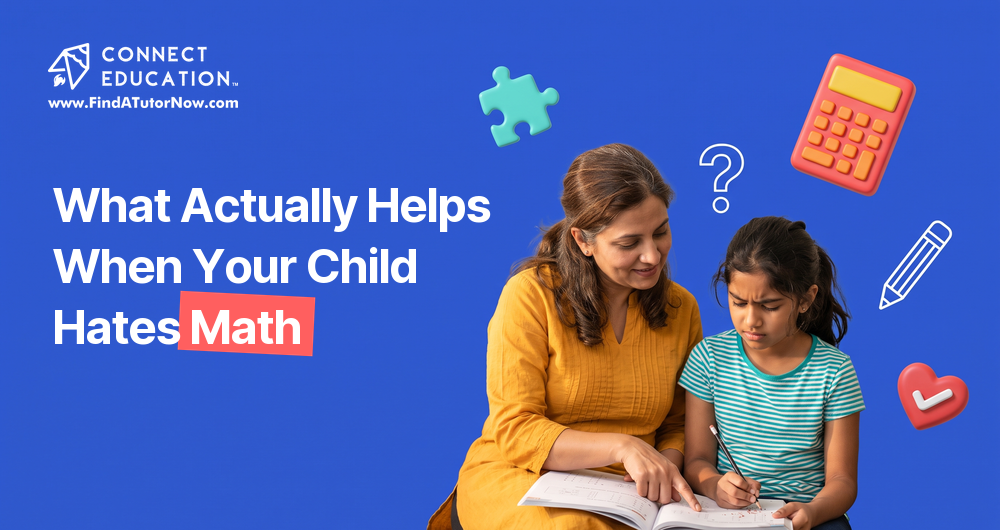
If your child says "I hate math" more than any other subject, the research suggests it is worry doing most of the damage, not ability, and worry responds to different fixes than a skill gap does.
Every parent of a school-age child has heard some version of it: a slammed workbook, a sudden stomachache right before homework time, or a flat "I'm just bad at math" delivered like a fact rather than a feeling. It is one of the most common flashpoints in Canadian households, and it is rarely about the numbers themselves.
Researchers have a name for what is actually happening in a lot of these moments, and a growing, genuinely recent body of work on what helps. None of it starts with more worksheets.
Is Math Anxiety a Real Thing, or Is My Child Just Being Dramatic?
Yes. Math anxiety is a real, measurable response, not laziness or a character flaw: researchers define it as feelings of tension and worry that interfere with a person's ability to work through numbers, and it can start as early as elementary school.
On the OECD's PISA 2022 assessment, more than 6 in 10 students across participating countries said they worry about their ability to succeed in math class, a pattern the OECD has tracked since 2012 and one that has gotten measurably worse in more than three dozen countries over that decade (OECD, 2022, via UNESCO GEM Report SCOPE, 2024). A more recent scoping review of 132 studies published between 2019 and 2025 puts the estimate for young learners experiencing genuine math anxiety at over one in three, and found that it tends to climb with each grade level rather than fade out (Frontiers in Psychology, 2026).
Why So Many Kids Say They Hate Math
Math is unusually unforgiving compared to other subjects, in a way that feeds anxiety directly. A single wrong step early in a problem makes everything after it wrong too, and there is rarely partial credit for an answer that shows the right idea but the wrong number. A child who gets used to being marked entirely wrong for one small slip starts to associate the subject with failure long before the material itself gets genuinely difficult.
The 2026 scoping review found a consistent gender pattern behind that experience: girls report higher math anxiety than boys across most of the studies reviewed, and anxiety in general tends to climb with each grade level rather than fade out (Frontiers in Psychology, 2026). Canadian data tells a related, more specific story. On the same PISA 2022 assessment, boys outperformed girls in math by an average of 12 points nationally, a statistically significant gap that showed up in every province except Quebec (CMEC, 2023). Performance gaps and anxiety gaps are not the same thing, but they tend to travel together.
The Worry Is Bigger Than the Actual Gap
Here is the part that should be reassuring, not discouraging: for most Canadian kids, the worry is running well ahead of the reality. On PISA 2022, 78 percent of Canadian 15-year-olds met the baseline level of math proficiency needed to function well in daily life and further schooling, above the OECD average of 69 percent, and Canada's average math score outperformed all but eight of the 81 participating countries (CMEC, 2023). Put plainly, most kids who say they hate math are more capable in it than they currently believe.
That gap between confidence and competence is exactly what math anxiety does. It does not usually mean a child cannot do the work. It means a child has started to believe they cannot, and that belief starts interfering with their working memory in the moment they most need it, which is often what turns a solvable problem into a shutdown.
Could Your Own Math Anxiety Be Rubbing Off?
A 2026 Canadian study led by researchers at the University of Ottawa, working with colleagues at Carleton, Concordia, and the University of Winnipeg, followed 106 parent-child pairs across Canada and found that a parent's own math anxiety shaped how their child perceived them, specifically how much the child thought their parent actually enjoyed math (Retanal et al., Child Development, 2026). Higher parental math anxiety predicted that children saw their parent as enjoying math less, and that link was stronger for daughters than for sons.
You do not have to love math to help your child with it, and pretending to enjoy something you dread usually does not fool a nine-year-old anyway. What the research points to instead is how you react in the moment a problem gets hard: a sigh, a sharp "I was never good at this either," or visible frustration reads to a child as confirmation that math is something to fear, regardless of what you meant by it.
What Actually Helps at Home
- Separate the emotion from the math. If your child is mid-meltdown, stop the math first and address the feeling. No one, child or adult, does their best problem-solving while their heart is racing.
- Praise the process, not the speed. Fast is not the same as good at math. Kids who are taught to value understanding over speed report lower anxiety and stronger long-term results than kids drilled purely on quick recall.
- Watch your own math talk. Skip "I was never a math person" even as a joke. It hands your child a ready-made excuse and, per the 2026 Ottawa research, can shape how much they think you enjoy the subject in the first place.
- Normalize getting it wrong. Mistakes are where the actual learning happens in math more than almost any other subject. Treating a wrong answer as useful information, not a failure, takes some of the sting out of trying.
- Watch for physical signs, not just refusal. A stomachache, a racing heart, or sudden tears right before math homework are anxiety symptoms, not manipulation. Responding to the symptom calmly tends to work better than responding to the behaviour with pressure.
When It's More Than Anxiety
Not every child who struggles with math is anxious rather than genuinely behind, and the two often overlap. If your child understands a concept out loud but freezes the moment it is written down, if the same type of problem trips them up every time regardless of effort, or if the anxiety does not ease even once a concept has clearly clicked, that pattern is worth raising with their teacher. A persistent, specific struggle with number sense despite steady effort can also be a sign of dyscalculia, a learning difference that benefits from a different kind of support than confidence-building alone.
How Connect Education Can Help
Connect Education works exclusively with certified teachers in good standing with their provincial college of teachers, matched to your child's grade and the specific concept causing the friction, not generic math drilling. A free 15-minute assessment is a low-pressure way to find out whether what you are seeing is anxiety, a specific skill gap, or both, before deciding what kind of support fits.
Sessions run online, in person, or at your local library, built around a one-on-one learning plan rather than a fixed curriculum pace. If you are still deciding whether outside support makes sense at all, How to Tell If Your Child Needs a Tutor walks through the signs, and if evenings at your house are tense for reasons beyond math specifically, What Actually Helps When Homework Is a Nightly Fight covers that ground directly. Full detail on scheduling and billing is in the FAQ.
Questions Parents Ask Most
Why does my child suddenly hate math?
It is rarely sudden, and it is rarely about ability. A missed concept a few weeks or months back often keeps quietly compounding until a child feels lost every time new material builds on it, and "I hate math" becomes an easier thing to say than "I do not understand this anymore." Once you know it is usually a specific gap rather than a general dislike, it becomes something you can actually address.
My child cries or panics during math homework. Is that normal?
It is common enough to have a clinical name, math anxiety, and it shows up as real physical and emotional symptoms including a racing heart, stomachaches, tears, or a full shutdown at the sight of a worksheet. It is not the same as your child being dramatic or avoiding work. Those reactions are a stress response, and pushing through them by force usually makes the next session harder, not easier.
Is math anxiety a real thing, or is my child just being dramatic?
Math anxiety is real and well documented in research going back decades, and it is distinct from simply disliking a subject. It is a specific feeling of tension and worry that interferes with a child's ability to work through numbers, even when they understand the underlying concept, and it appears in students who are otherwise strong learners just as often as it does in students who are behind.
Can math anxiety be fixed once it starts?
Yes, and it tends to respond well to fairly specific changes rather than requiring years of intervention. Building understanding instead of speed, separating a skill gap from an emotional reaction, and being careful about the language adults use around math at home have all been shown to reduce it over weeks and months, not years. The earlier it is addressed, the less it compounds.
Could my own dislike of math be rubbing off on my child?
It can, particularly during homework help. A 2026 Canadian study found that when parents had higher math anxiety themselves, their children were more likely to perceive them as enjoying math less, and that perception mattered more for daughters than for sons. You do not need to love math to help your child with it, but how you react in the moment when a problem gets hard sends its own message.
Sources
- UNESCO GEM Report SCOPE, Mathematics Anxiety (2024), citing OECD PISA 2022 results, https://www.education-progress.org/en/focus/28-mathanxiety
- Council of Ministers of Education, Canada, Measuring Up: Canadian Results of the OECD PISA 2022 Study (2023), https://cmec.ca/docs/pisa2022/PISA-2022_Highlights_FINAL_EN.pdf
- What Shapes Mathematics Anxiety in K-12 Education? A Scoping Review of Research from 2019 to 2025, Frontiers in Psychology (2026), https://pmc.ncbi.nlm.nih.gov/articles/PMC13490170/
- Retanal, F. et al., Children's Perceptions of Parents' Math Attitude Moderate the Relation Between Parents' Math Anxiety and Children's Math Anxiety, Child Development (2026), https://academic.oup.com/chidev/advance-article/doi/10.1093/chidev/aacag121/8729126
