

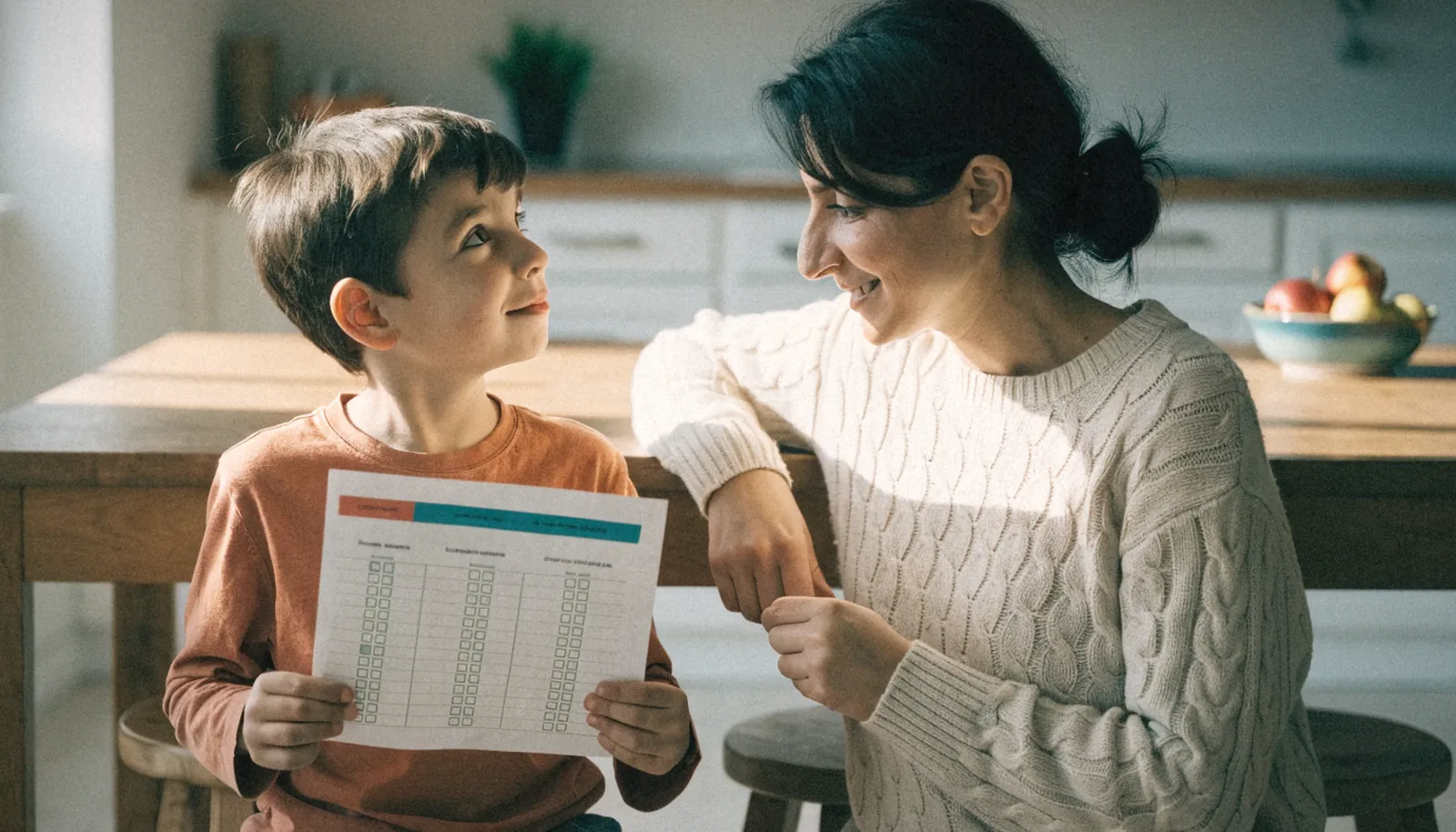
If your child comes home in November with a checklist instead of a grade, marked "Progressing Well" instead of a letter or a percentage, that is not a mistake. It is Ontario's fall progress report, and it works differently from the report cards that follow it.
Every Ontario student in Grades 1 to 8 gets one of these in the fall, and every year it produces the same wave of parent questions. What does "progressing well" actually mean? Is "progressing with difficulty" something to worry about? Why does it look nothing like the report card that showed up in June?
What Is Ontario's Fall Progress Report, and How Is It Different From a Report Card?
Ontario's fall progress report is a checklist-based update sent home between October 20 and November 20 that shows how your child is starting the school year. It uses three descriptive terms instead of grades, and it exists to open a conversation between home and school early, not to deliver a final mark.
Elementary students in Grades 1 to 8 receive three formal, required reports each year. The fall progress report comes first, followed by the first provincial report card between January 20 and February 20, and the second provincial report card at the end of the school year in June (Ontario Ministry of Education, 2026). Only the two provincial report cards carry letter grades or percentages. The fall progress report reports on all academic subjects, including language, math, social studies, and science and technology, but it describes progress rather than scoring it.
| What you're looking at | Fall Progress Report | Provincial Report Card |
|---|---|---|
| When it arrives | Between October 20 and November 20 | Late January to February, and again in June |
| How progress is scored | Progressing Very Well, Progressing Well, or Progressing With Difficulty | Letter grades (Grades 1 to 6) or percentages (Grades 7 to 12) |
| What it's meant to do | Open a conversation early in the year, not deliver a final verdict | Report actual achievement against the curriculum at a fixed point |
| Learning skills | Rated on the same six categories as the full report card | Same six categories, tracked across the full year |
What Do "Progressing Very Well," "Progressing Well," and "Progressing With Difficulty" Actually Mean?
These three terms are not the same scale as the letter grades or achievement levels used later in the year. According to York Region District School Board, teachers use this rating scale specifically because the fall report is meant to communicate a child's progress toward curriculum expectations, not their achievement of them, and it "is to communicate your child's progress towards the achievement of the curriculum expectations" as "a central part of early discussions between home and school" (York Region District School Board, 2026).
In practice, "Progressing Well" is the expected result for most students at this point in the year. It means your child is on track, not that they are merely adequate. "Progressing Very Well" usually signals strong progress toward this year's expectations. "Progressing With Difficulty" means the opposite: your child needs more time or more support with a specific expectation right now. It is an early flag, not a verdict, which is exactly why it arrives months before the year ends rather than at the end of it.
Alongside the checklist, teachers write personalized comments describing what your child has learned so far, their strengths, and specific next steps. Those comments carry more useful detail than the checklist term itself, so it is worth reading them closely rather than reacting to the rating alone.
The Six Learning Skills Every Ontario Report Tracks
Both the fall progress report and the provincial report cards rate your child on the same six learning skills and work habits: responsibility, organization, independent work, collaboration, initiative, and self-regulation (Ontario Ministry of Education, 2026). Each skill is rated E (Excellent), G (Good), S (Satisfactory) or N (Needs Improvement) (York Region District School Board, 2026). These are scored separately from academic progress, and they are often the first place a teacher notices a child who needs a little more support.
- Responsibility. Following through on tasks and routines without being reminded repeatedly.
- Organization. Managing materials, time, and multi-step tasks.
- Independent work. Staying on task and completing work without constant support.
- Collaboration. Working effectively and respectfully with classmates.
- Initiative. Approaching new tasks with curiosity and taking on challenges.
- Self-regulation. Managing frustration, setting goals, and adjusting behavior independently.
If your child's academic progress looks fine but one or two of these skills stand out as an area to watch, that comment is worth a conversation with the teacher. A child who is organized and can work independently tends to close academic gaps faster than one who is not, regardless of subject. For what each rating means and one small step to try at home, see our guide to Ontario learning skills on the report card.
Ontario Has Brought Back Paper Report Cards
In March 2026, Ontario's government announced it would require school boards to resume printing physical report cards alongside the digital versions most families now receive. Education Minister Paul Calandra said parents had told the ministry they needed "five different passwords in three different systems to get to the report," and a spokesperson added that "parents deserve clear and straightforward access to information about their child's education" (CP24, March 4, 2026). Beginning with the June 2026 reporting period, every student in Kindergarten to Grade 8 receives a paper copy of the winter and June reports (the Communication of Learning in Kindergarten, the provincial report card in Grades 1 to 8), and the online version stays available too (Upper Grand District School Board, June 9, 2026; Global News, March 5, 2026).
The paper requirement covers the two provincial report cards. The fall progress report can still arrive electronically: Upper Grand, for example, sends it online only and prints a copy if you ask the school office (Upper Grand District School Board, June 9, 2026). Check how your board delivers it this fall. The change does not affect what the checklist terms mean, but a paper copy of the winter and June report cards makes it easier to compare progress across the year.
Parents of high school students can find this year's changes to final grades and exams in our guide to Ontario report cards.
How Connect Education Can Help
A "Progressing With Difficulty" note, or a learning skill flagged as an area to watch, is useful precisely because it arrives early enough to act on. Connect Education works exclusively with licensed teachers, matched to your child's specific subject and grade, so support can start on the exact gap the fall report describes rather than a generic review.
Sessions run online, at your home, or at your local public library, on a schedule that fits your family. If you want a fuller walkthrough of how the full report card works later in the year, our guide to understanding Ontario report cards covers grades, percentages, and comment language in detail. And if you are not yet sure whether the fall report reflects a passing dip or something worth addressing, our guide on signs your child may need a tutor can help you tell the difference.
A free 15-minute assessment identifies exactly where a certified teacher can help before any sessions begin, so no time is spent reviewing material your child has already mastered.

 Certified teachers
 Online, home or library